
Objectives
NuClim will use high-quality measurements of atmospheric radon activity concentration and ambient radioactivity to advance climate science and to improve radiation protection and nuclear surveillance capabilities.
The project will provide accurate time-varying “baseline” levels of greenhouse gases in the remote North Atlantic region based on high quality radon measurements. This will enable clearer distinction to be made at downwind locations between European emissions and changing background levels. In addition, radon observations will inform the degree of recent terrestrial influence on air masses, providing a basis for
- identifying/quantifying pollution events and regional greenhouse gas emissions,
- investigating the contributions of natural planktonic communities to changing greenhouse gas levels,
- understanding cloud and aerosol variability in the marine boundary layer, and
- evaluating the performance of regional/global chemical transport models.
Additionally, through simultaneous measurement of the ambient gamma dose rate, NuClim will contribute to existing nuclear surveillance networks, as an improved understanding of the influence of meteorological processes on the near-surface gamma dose rate will assist with the setting of alarm level thresholds.
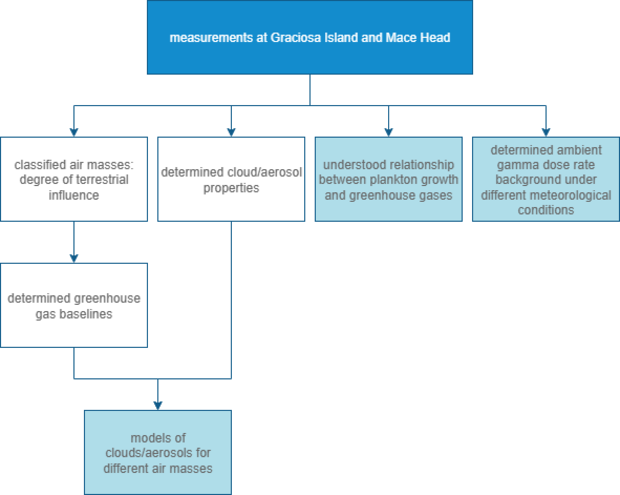
Measurements at Graciosa Island and Mace Head
The core of the project consists of the measurement campaigns undertaken at Graciosa Island (Azores, Portugal) and Mace Head (Ireland). These campaigns will provide the necessary datasets to achieve each of the project goals.
Classification of air masses
The most fundamental step at each site is to use the radon observations to establish a high temporal resolution “indicator series” of relative terrestrial influence on air masses arriving at each site. Location dependent, seasonal radon concentration thresholds will be established to identify a minimum of three degrees of relative terrestrial influence: least influenced, minor influence, and most influenced. In many cases the degree of terrestrial influence that an air mass has been subjected to will determine how it should be utilised in further analysis.
In conjunction with the indicator series of relative terrestrial influence, the meteorological, atmospheric radon, greenhouse gas and other pollution measurements, will be used.
Determination of greenhouse gas baselines
Each month, the least terrestrially influenced air masses (as determined by radon concentration) will be investigated to characterise time varying “baseline” concentrations of greenhouse gases in the remote marine boundary layer. Numerical “gap filling” techniques will be employed to derive seasonal “baseline” values for each species at each measurement site. Time varying greenhouse gas baseline values determined by this method can then be compared with other baseline approaches.
Models of cloud and aerosol for different air masses
Each month, cloud and aerosol observations can be grouped according to the degree of terrestrial influence on the parent air masses. In this way, improved understanding can be derived regarding the aerosol sources and variability (marine, recent continental, or tropospheric), and the potential impact of these aerosols of different origin on cloud type, formation and distribution. This information may lead to improved parameterisation of cloud processes in models. It may also help to distinguish between natural and anthropogenic influences on cloud formation and distribution.
Each month, the most terrestrially influenced air masses can be analysed (in conjunction with back trajectory or particle dispersion models) to quantify net event pollution magnitudes (observed – baseline concentrations), or to make regional greenhouse gas emissions estimates using the Radon Tracer Method (RTM, Biraud et al., 2000).
The ability of a regional or global Chemical Transport Model (used in conjunction with a corresponding regional or global radon flux model) to simulate atmospheric radon activity concentrations in the marine boundary layer at remote island or coastal sites is an effective means of testing the fidelity of its parameterisations for atmospheric transport and mixing. The observed versus simulated radon bias could be investigated in conjunction with local observed, or remotely sensed, meteorology data, to determine the conditions under which the model’s parameterisations are most realistic.
Understanding the relationship between plankton growth and greenhouse gases
Each month, satellite-derived measurements of chlorophyll a will be combined with seasonal observations of planktonic microbial communities to assess their role in greenhouse gas dynamics. The abundance of key microbial players will be quantified and related to observed greenhouse gas concentrations, while novel bottle-based experiments will directly link community composition and activity to uptake and emission processes, including the influence of potential fertilization events such as dust inputs. This seasonal perspective will provide new insight into how offshore microbial communities at the Graciosa observatory respond to increasing atmospheric CO2 and their potential feedback to climate.
Determination of the ambient gamma dose rate under different conditions
Nuclear surveillance networks rely on near surface ambient gamma dose rate thresholds to raise alarms. However, there are a variety of natural phenomena that influence near surface gamma dose rates to varying degrees over the course of a day. Improving understanding of these processes, as well as the general nature and magnitude of their influences, could potentially improve the sensitivity of the surveillance networks. Meteorological information (specifically rainfall type and duration), in conjunction with observed gamma dose rates, can be used to develop or improve models of washout of gamma-emitting radon progeny within or beneath clouds (Melintescu et al., 2018). Large, rapid (3 hour to 6 hour) changes in near surface radon concentration can also lead to variability in the near surface gamma dose rate. Such variability can be caused by sudden changes in air mass fetch, or large changes in the nocturnal atmospheric mixing state. Investigations of gamma dose and radon observations during periods of high terrestrial influence will help to quantify the magnitude of these influences and thereby inform (or help evaluate) models intended to relate gamma dose to meteorological parameters. Improved modelling of meteorological effects on gamma dose will improve the performance of nuclear surveillance networks for radiological protection purposes. The combined use of automated event detection and a process level model could enable the ambient dose “attention limit” (which indicates a potential radiological emergency) to be reduced from 200 % – 400 % above background to 25 % – 50 %.
All collected data, initial data products (for example terrestrial influence indicator series), and new or improved models will be made openly available to external users and appropriately communicated to a broad audience. Due to the interdisciplinary character of the project, several scientific communities will benefit from the gathered data and developed models. In addition, the results will also be communicated to stakeholders, including the public.