
NuClim M18 meeting
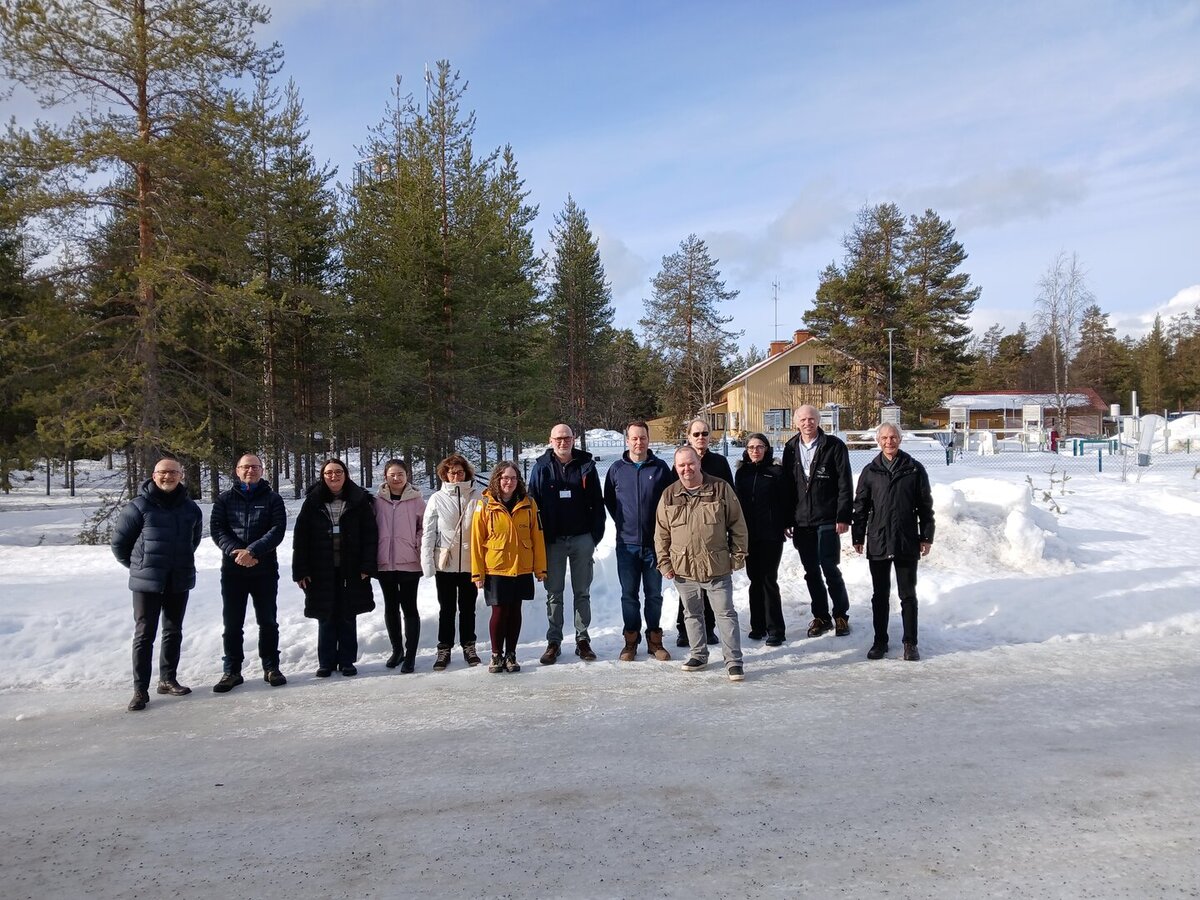
The M18 project meeting took place on March 24 and 25, 2026, in Finland, with the goal to provide a space for exchange and discussions. Representatives of the project partners met in Rovaniemi and jointly traveled to the Sodankylä Geophysical Observatory, a separate department of the University of Oulu.
During the first day, finished and ongoing activities within the different work packages were presented and the results and future perspectives were discussed.
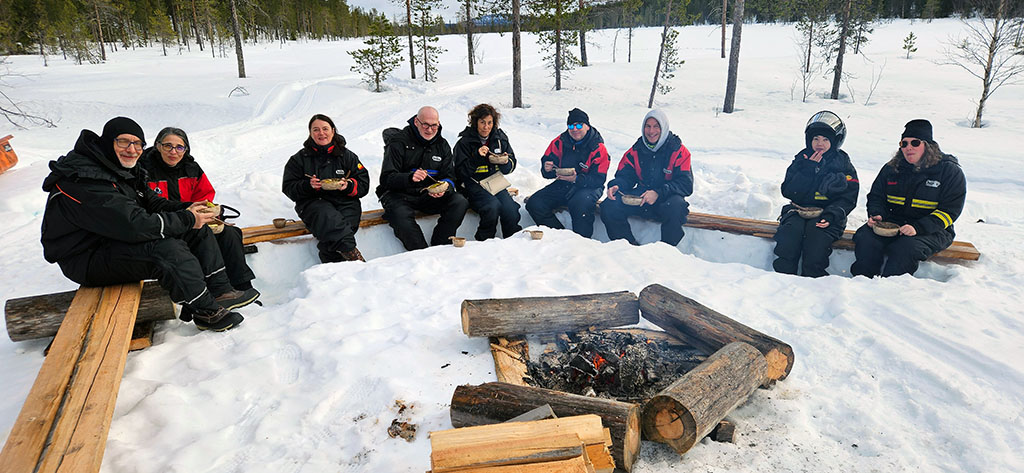
The next day, the group mounted snowmobiles and headed further North to reach the Pallas GAW-ICOS station. This site is said to have the cleanest air in Europe, making it especially sensitive to air pollutants and greenhouse gases and thus an important place for atmospheric measurements. Taking a break from the tight schedule, the guests could experience the Finnish hospitality during a field lunch in the scenic landscape.
After returning to Rovaniemi and Helsinki, some participants took the opportunity to visit the SMEAR II station, located in the Hyytiälä forest station of the University of Helsinki, in Juupajoki in southern Finland. The measurements conducted at the site include e.g. greenhouse gases, volatile organic compounds, pollutants, aerosols but also soil humidity using cosmic-ray neutron sensing (CRNS).
NuClim presentation series - recorded presentations
14 January 2026, 15-16 UTC - Using Radon and Nuclear Measurements for Climate and Greenhouse Gas Research – an overview of project NuClim
Project NuClim uses high-quality measurements of atmospheric radon activity concentration and ambient radioactivity to support both climate research and radiation protection applications. This presentation provides a scientific overview of the project, including its field campaigns, and illustrates how nuclear measurements can improve greenhouse gas emission estimates as well as nuclear surveillance capabilities.
About the speaker:
Susana Barbosa is a senior researcher at INESC TEC (Porto, Portugal) and the coordinator of project NuClim. She has a background in physics and applied mathematics (astronomy), and holds a master’s degree in scientific computing and a PhD in surveying engineering. Her interdisciplinary research focuses on data science, particularly the time-series analysis of environmental data. Since 2015, she has led the “Gamma Radiation Monitoring Campaign” at the ENA-ARM station on Graciosa Island (Azores) and is also the Principal Investigator of the NuClim campaign.
Watch the recording of the presentation
28 January 2026, 15-16 UTC - Radon Measurements for GHG tracing
The presentation covers the importance of radon as a tracer and how we are measuring it at ENA station (Graciosa Island, Azores) and Mace Head station (Ireland). We also present the method on how to classify air masses with radon and application on N₂O at three example main baseline sites and how NuClim will contribute to the network of measurement stations.
About the speaker:
Craig Lils is a Graduate Scientist at NPL working on Greenhouse Gas Metrology to improve our understanding of uncertainty in emissions estimates. He did a MSc in Natural Sciences at the University of Exeter which equipped him with experience in climate science and data analytics.
Watch the recording of the presentation
11 February 2026, 15.30-16.30 UTC - Atmospheric aerosol and pollution
Atmospheric aerosol particles play an important role in forming low-level clouds in marine environments. Understanding their properties in clean and polluted air masses provides insights in evaluating aerosol radiative forcings. Radon-based air mass classification is a powerful tool in isolating air masses of marine origins. Aerosol measurements help identify local pollution interference in greenhouse gas baseline determination.
About the speaker:
Xuemeng Chen (Ava) is a university researcher working in the Institute for Atmospheric and Earth System Research (INAR) of the University of Helsinki. Her main research focus is on atmospheric clusters and nanoparticles, especially air ion properties as well as their formation and linkage to atmospheric radioactivity and electricity. In NuClim, she is responsible for NAIS, PSM, ACSM and PTR-ToF measurements at the ENA station (Graciosa, Azores) and leads WP3 data analysis and interpretation on aerosols and clouds.
Watch the recording of the presentation
25 February 2026, 15-16 UTC - Phytoplankton and the marine carbon cycle
The presentation addresses the role of marine primary producers, phytoplankton, in the ocean and their importance for the global carbon cycle. It combines in situ observations from the Azores with data from European satellite missions to illustrate how remote sensing can be used to study phytoplankton dynamics under ongoing climate change and rising atmospheric CO₂. The presentation also gives insights into current research on seasonal variability in phytoplankton communities and its influence on the local carbon cycle.
About the speaker:
Paula Eisnecker is an early-career scientist at the University of the Azores working with remote sensing data to improve the understanding of local phytoplankton dynamics and their links to ocean–atmosphere CO₂ exchange. She graduated at the University of Tübingen in Germany and previously worked at GEOMAR Marine Research Institute in Germany, where she focused on climate-relevant trace gases (CO₂, N₂O, CH₄, CO) in the ocean and participated in several research cruises in subtropical and tropical regions. This background provides her with knowledge about marine gas cycles she can include in her current work within NuClim.
Watch the recording of the presentation
11 March 2026, 15-16 UTC - Application of Machine Learning and Data-driven Modeling in Climate Monitoring
The talk shall focus on developing an integrated modeling framework that combines nuclear observations with greenhouse gas measurements (CO₂ and CH₄), and aerosol-cloud properties to improve European GHG emission estimates and climate research. The core methodology shall employ radon-based air mass classification to establish universal baseline atmospheric conditions, supplemented by machine learning algorithms that predict aerosol and cloud properties from terrestrial influence indicators. Predictive data-driven models integrate multiple measurement streams to characterize pollution events, quantify marine GHG emissions, and enhance gamma dose rate surveillance, ultimately reducing uncertainties in climate projections and strengthening capacity to monitor compliance with GHG mitigation measures.
About the speakers:
Aimon Tanvir is a Postdoctoral Researcher at University of Galway, Ireland, stationed at Mace Head Atmospheric Research station where she contributes to projects related to greenhouse gas observations and nuclear measurements for climate research. She holds a PhD in Environmental Science from Fudan University, Shanghai, with research focused on the spatial distribution of trace gases and ozone sensitivity. Her expertise lies in atmospheric science, climate change, remote sensing, and environmental data analysis, with strong experience in field measurements, instrument deployment, and interpretation of long-term greenhouse gas observations. Her current work includes radon observations at Mace Head as well as ICOS instrument maintenance, atmospheric sampling, and analysis of historical greenhouse gas datasets across monitoring stations. She is skilled in quantitative research methods and scientific data analysis.
Anca Melintescu is a Senior Scientist at the “Horia Hulubei” National Institute of Physics and Nuclear Engineering in Măgurele, Romania, with a 30 years extensive experience in radiological risk assessment in environment. She holds a PhD in Nuclear Physics from the University of Bucharest, Romania. Her research expertise focuses on mathematical modelling of radionuclide transfer in different ecosystems and associated data bases, atmosphere – land interaction, radioecology and nuclear meteorology. She coordinates the Survey System for Meteorology and Radiation (SSMR) of IFIN-HH. Within the NuClim project, she models the increase of ambient dose rate due to radon and other meteorological factors.
NuClim M9 meeting
After the first nine months of the project, an online meeting was held on 27th May 2025. In the meeting, the planned measurements were discussed in detail: what would be measured and why? How would the measurements contribute to the project’s goal? How is the field campaign organised? And at what stage are the preparations for the measurements? Based on these discussions, the set-up of the additional measurement instruments at Graciosa Island can now start.

The NuClim kick-off meeting
The official kick-off of the project took place between September 30 and October 2, 2024, in the Azores, during an event organised by the University of the Azores, one of the project partners. On these three days the project consortium met: partners from INESC TEC, Finnish Meteorological Institute (Finland), Horia Hulubei National Institute for Research and Development in Physics and Nuclear Engineering (Romania), Physikalisch-Technische Bundesanstalt (Germany), National University of Ireland Galway (Ireland), University of Helsinki (Finland), University of Lodz (Poland) and the University of Azores, as well as the associates partners from NPL and the University of Bristol (both UK) and collaborators from ANSTO (Australia). They visited the measurement side at Graciosa Island where key measurements of the project will take place, discussed the planned measurement campaign and how the data will be managed. After the meeting, all is set for a successful start into the project.
The project consortium combines the expertise of the project partners in greenhouse gas emission measurements and atmospheric radon measurements. INESC TEC, is the coordinator and manager of the project. They are also responsible for measuring the environmental gamma dose rate using Nal2 detectors on Graciosa Island since 2015. The data is available open source in the institutions’ repository: the repository.